
Introduction
Labor costs are one of the biggest challenges faced by manufacturers, especially in industries that require repetitive assembly processes. Rising wages, labor shortages, and increasing production demands have pushed companies to find more efficient manufacturing solutions.
Automatic assembly machines help manufacturers reduce dependence on manual labor while improving production speed, accuracy, and consistency. By automating repetitive tasks such as feeding, assembling, inspection, and packaging, companies can optimize workforce utilization and achieve long-term cost savings.
For manufacturers looking for customized automation solutions, automatic assembly machines provide a reliable way to improve productivity while maintaining high-quality production standards.
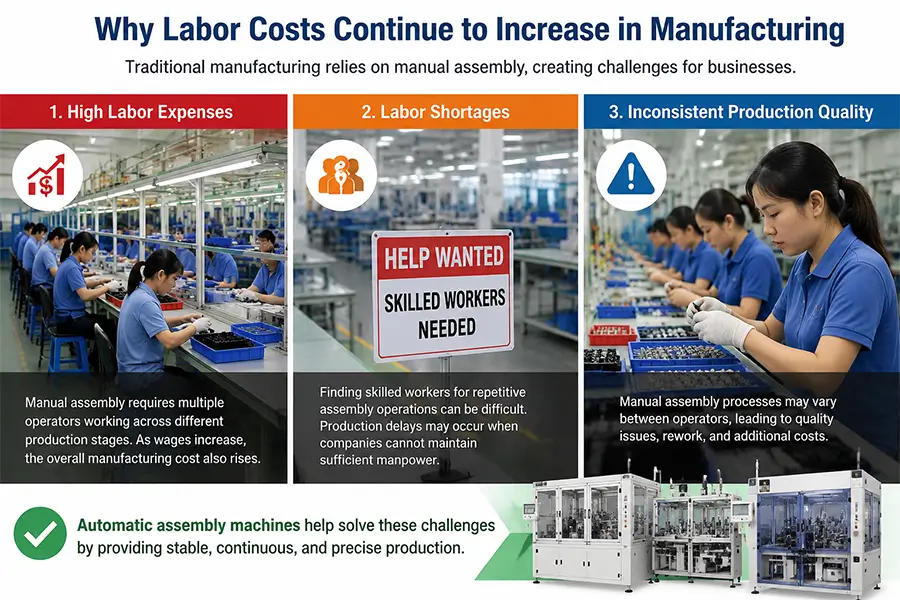
Why Labor Costs Continue to Increase in Manufacturing
Traditional manufacturing processes often rely heavily on manual operators for repetitive assembly tasks. This creates several challenges:
1. High Labor Expenses
Manual assembly requires multiple operators working across different production stages. As wages increase, the overall manufacturing cost also rises.
2. Labor Shortages
Finding skilled workers for repetitive assembly operations can be difficult. Production delays may occur when companies cannot maintain sufficient manpower.
3. Inconsistent Production Quality
Manual assembly processes may vary between operators, leading to quality issues, rework, and additional costs.
Automatic assembly machines help solve these challenges by providing stable, continuous, and precise production.
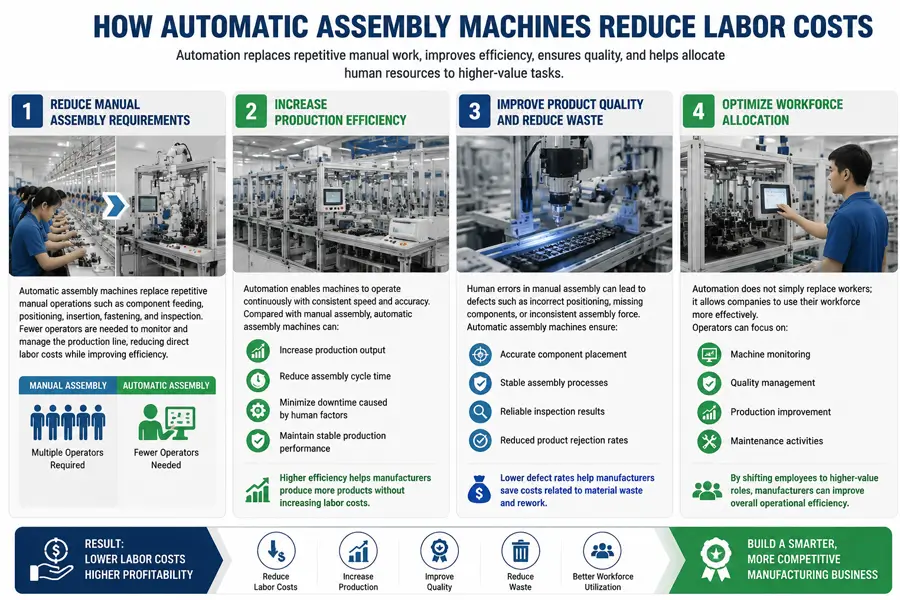
How Automatic Assembly Machines Reduce Labor Costs
1. Reduce Manual Assembly Requirements
Automatic assembly machines can replace repetitive manual operations with automated processes. Tasks such as component feeding, positioning, insertion, fastening, and inspection can be completed automatically.
Instead of assigning multiple workers to repetitive tasks, manufacturers can use fewer operators to monitor and manage the production line.
This allows companies to reduce direct labor costs while improving production efficiency.
2. Increase Production Efficiency
Automation enables machines to operate continuously with consistent speed and accuracy.
Compared with manual assembly, automatic assembly machines can:
- Increase production output
- Reduce assembly cycle time
- Minimize downtime caused by human factors
- Maintain stable production performance
Higher efficiency helps manufacturers produce more products without increasing labor costs.
3. Improve Product Quality and Reduce Waste
Human errors are common in repetitive assembly operations. Incorrect positioning, missing components, or inconsistent assembly force can lead to defective products.
Automatic assembly machines use precise mechanisms and control systems to ensure:
- Accurate component placement
- Stable assembly processes
- Reliable inspection results
- Reduced product rejection rates
Lower defect rates help manufacturers save costs related to material waste and rework.
4. Optimize Workforce Allocation
Automation does not simply replace workers; it allows companies to use their workforce more effectively.
Operators can focus on:
- Machine monitoring
- Quality management
- Production improvement
- Maintenance activities
By shifting employees from repetitive manual tasks to higher-value roles, manufacturers can improve overall operational efficiency.
Applications of Automatic Assembly Machines
Automatic assembly machines are widely used in industries that require high-volume and precise manufacturing, including:
Electronics Manufacturing
Used for assembling connectors, electronic components, sensors, and small precision parts.
Medical Device Production
Applied in products such as syringes, needles, and disposable medical components where accuracy and cleanliness are critical.
Automotive Components
Used for assembling small automotive parts, electrical components, and mechanical assemblies.
Plastic and Metal Parts Manufacturing
Suitable for automated feeding, assembly, testing, and inspection processes.
Why Choose Customized Automatic Assembly Machines?
Different products have different shapes, sizes, and assembly requirements. Standard machines may not always meet specific production needs.
Customized automatic assembly machines are designed according to:
- Product specifications
- Production capacity requirements
- Assembly processes
- Factory layout
- Quality standards
A customized automation solution helps manufacturers achieve better performance, lower operating costs, and higher return on investment.
Key Benefits of Automatic Assembly Machines
By implementing automatic assembly systems, manufacturers can achieve:
✅ Lower labor costs
✅ Higher production capacity
✅ Improved product consistency
✅ Reduced manufacturing errors
✅ Better workforce utilization
✅ Long-term operational savings
Conclusion
Automatic assembly machines provide an effective solution for manufacturers looking to reduce labor costs and improve production efficiency. By automating repetitive assembly processes, companies can reduce dependence on manual labor, improve product quality, and achieve more competitive manufacturing operations.
For manufacturers requiring flexible and customized automation solutions, investing in automatic assembly machines is a practical step toward building a smarter and more efficient production line.
FAQs
The amount of labor reduction depends on the product, assembly process, and machine design. Some automated systems can replace several manual workstations while improving production consistency.
Yes. Automatic assembly machines are widely used for small precision parts, including electronic components, medical devices, and plastic or metal parts.
Yes. Automatic assembly machines can be customized based on product requirements, production volume, assembly processes, and factory conditions.
Yes. By reducing manual labor requirements, improving efficiency, and minimizing defects, automatic assembly machines can significantly reduce overall manufacturing costs.
