
Introduction
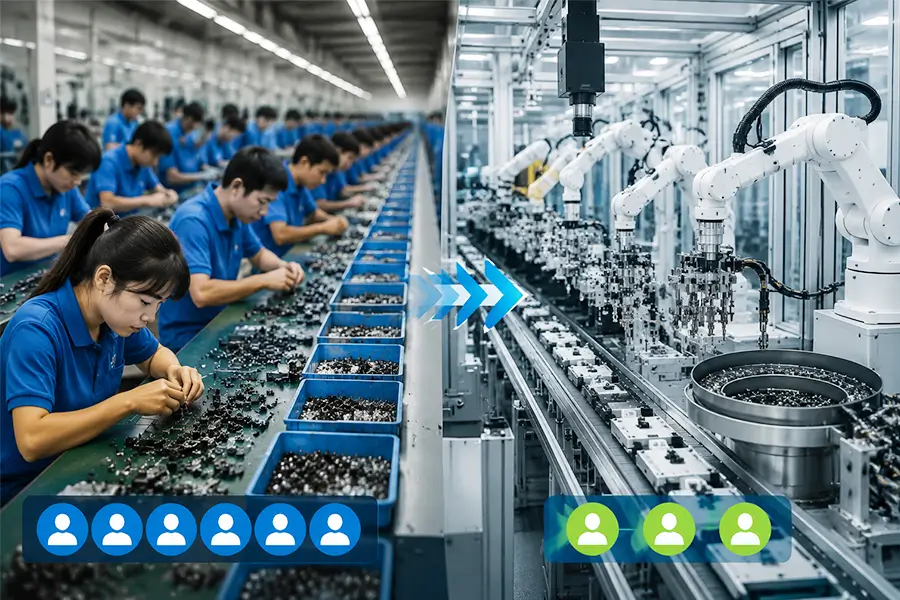
Manual assembly has been widely used in manufacturing for many years. It allows companies to handle different product types and small production volumes with flexibility. However, as production demands increase, manufacturers face challenges such as rising labor costs, inconsistent quality, and limited production capacity.
For industries requiring high precision and continuous production, relying only on manual assembly can reduce efficiency and affect product competitiveness.
Automation solutions, including automatic assembly machines, feeding systems, and robotic assembly systems, help manufacturers overcome these challenges by improving speed, accuracy, and production stability.
1. High Labor Costs in Manual Assembly
One of the biggest challenges of manual assembly is the increasing cost of labor.
Manufacturers need multiple operators to perform repetitive tasks such as:
- Component feeding
- Part positioning
- Assembly operations
- Screw fastening
- Quality checking
As production volume grows, companies must hire more workers to meet demand. This increases operating costs and makes production less competitive.
How Automation Solves It
Automatic assembly machines can replace repetitive manual operations with automated processes.
A customized assembly automation system can integrate:
- Automatic feeding systems
- Precision assembly mechanisms
- Robotic handling systems
- Vision inspection systems
This allows fewer operators to manage the production line while maintaining stable output.
2. Inconsistent Product Quality
Manual assembly depends heavily on operator experience and working conditions. Even skilled workers may produce different results due to:
- Fatigue
- Human errors
- Different assembly techniques
- Long working hours
Quality variation can lead to higher rejection rates and additional inspection costs.
How Automation Solves It
Automation equipment performs assembly tasks with consistent speed and accuracy.
Features such as:
- Servo-controlled positioning
- Precision tooling
- Automated inspection
- Real-time monitoring
help manufacturers achieve stable product quality and reduce production defects.
3. Limited Production Efficiency
Manual assembly speed is restricted by human capability. When demand increases, manufacturers may struggle to increase production capacity quickly.
Common problems include:
- Slow assembly cycles
- Production bottlenecks
- Difficulty meeting delivery schedules
How Automation Solves It
Automatic assembly machines can operate continuously with consistent cycle times.
Compared with manual processes, automated systems provide:
- Higher production output
- Faster assembly speed
- Reduced downtime
- Better production planning
Manufacturers can increase capacity without significantly expanding their workforce.
4. Difficulty Handling Small and Complex Parts
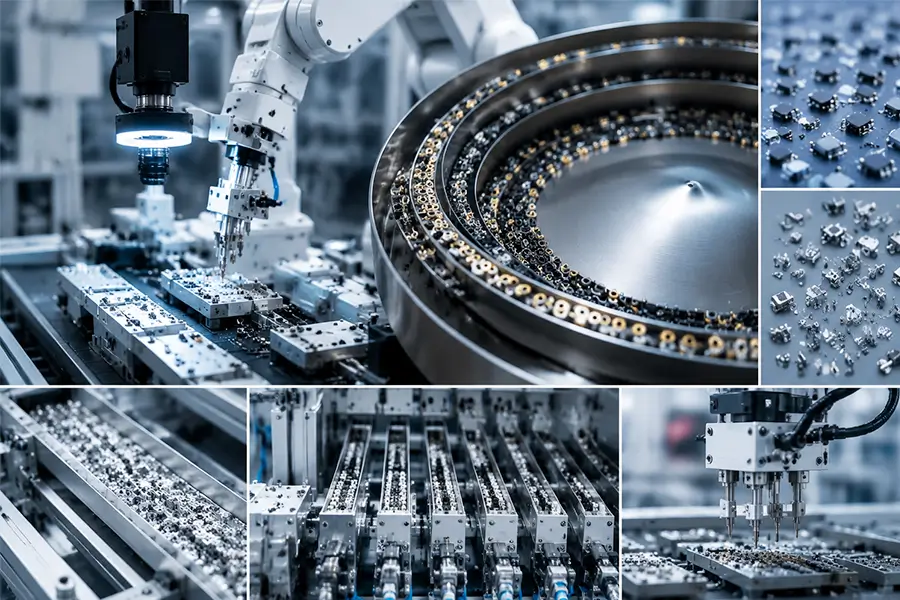
Many industries, including electronics, medical devices, automotive components, and precision hardware, require the assembly of small or delicate parts.
Manual handling may cause:
- Incorrect positioning
- Component damage
- Assembly errors
How Automation Solves It
Customized automation equipment can be designed according to specific product requirements.
Solutions such as:
- Vibratory bowl feeders
- Step feeders
- Flexible feeders
- Vision-guided robots
enable accurate feeding and positioning of complex components.
This improves reliability when handling small and precision parts.
5. Worker Safety Risks
Some assembly processes involve repetitive movements or require operators to handle components for long periods.
These conditions may lead to:
- Worker fatigue
- Repetitive strain injuries
- Reduced productivity
How Automation Solves It
Automation reduces the need for workers to perform repetitive and physically demanding operations.
Robotic systems can handle tasks such as:
- Material transfer
- Precision assembly
- Inspection
- Packaging
This creates a safer and more efficient working environment.
6. Lack of Production Data and Process Control
Manual assembly makes it difficult to collect accurate production data.
Manufacturers may have limited visibility into:
- Production speed
- Defect rates
- Machine performance
- Process efficiency
How Automation Solves It
Modern automation systems can integrate intelligent control and monitoring functions.
Manufacturers can track production performance and optimize processes through:
- PLC control systems
- Vision inspection data
- Automated reporting
- Smart manufacturing systems
This helps companies make better production decisions.
Why Manufacturers Choose Customized Assembly Automation
Every product has different structures, components, and assembly requirements. Standard machines may not always provide the best solution.
Customized assembly machines are designed based on:
- Product specifications
- Production requirements
- Assembly processes
- Factory layout
- Quality standards
A professional automation manufacturer can provide complete solutions, including feeding, assembly, inspection, and integration.
Conclusion
Manual assembly can create challenges such as high labor costs, inconsistent quality, limited production capacity, and production risks.
By adopting custom automatic assembly machines and industrial automation solutions, manufacturers can improve efficiency, reduce costs, and achieve more reliable production performance.
For companies looking to upgrade their manufacturing processes, automation provides a practical solution to build faster, smarter, and more competitive production lines.
FAQs
Common problems include high labor costs, inconsistent quality, slow production speed, and difficulty handling complex components.
Automation improves efficiency by performing repetitive tasks faster, reducing human errors, and maintaining consistent production speed.
Yes. Customized assembly machines can be designed according to specific product structures, production requirements, and manufacturing processes.
Industries such as electronics, medical devices, automotive components, plastic parts, and precision hardware can benefit from assembly automation solutions.
