
Introduction
In modern manufacturing, efficiency and precision play a critical role in maintaining productivity. One of the most important automation devices used in assembly and packaging lines is the vibration bowl, also known as a vibratory bowl feeder. These systems automatically sort, orient, and feed parts to downstream machinery, reducing manual labor and improving production consistency.
Industries across Malaysia, including electronics, automotive, medical devices, consumer products, and packaging, rely on vibration bowls to streamline operations. Understanding how vibration bowls work can help manufacturers choose the right feeding solution and maximize automation performance.
What Is a Vibration Bowl?
A vibration bowl is an automated feeding system designed to separate, orient, and deliver parts in a consistent manner. It typically consists of a bowl mounted on a vibrating base drive unit.
When bulk parts are loaded into the bowl, controlled vibrations move them along a specially designed spiral track. During the feeding process, incorrectly positioned parts are rejected and returned to the bowl, while correctly oriented parts continue toward the exit track.
The system ensures that downstream equipment receives parts in the correct orientation and at the required production speed.
Main Components of a Vibratory Bowl Feeder
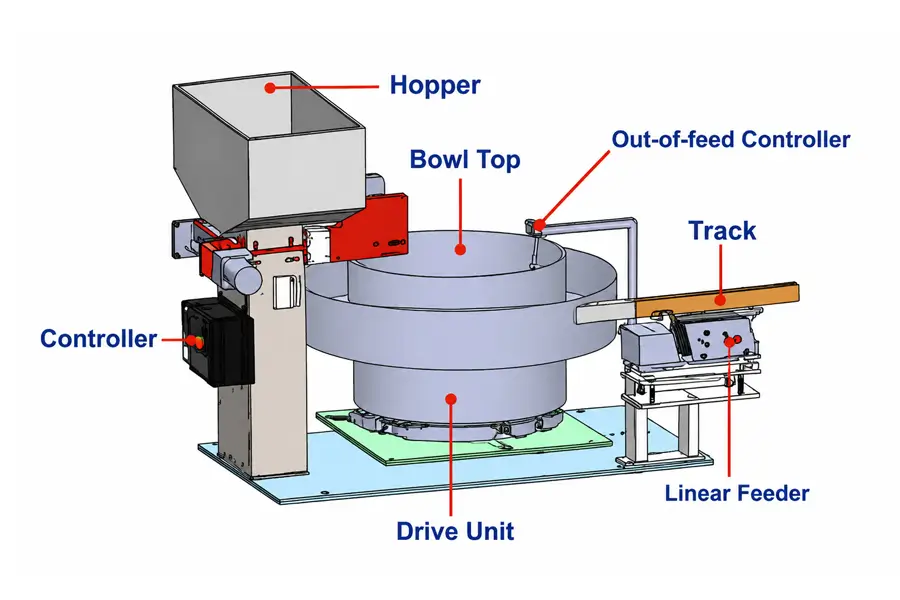
Several components work together to create a reliable feeding process:
| Component | Function |
| Hopper | Stores bulk parts and supplies them into the feeder system. |
| Bowl Top | Main bowl where parts are oriented and move along the spiral path. |
| Out-of-feed Controller | Controls and monitors the part flow to prevent overfeeding or blockage. |
| Track | Guides correctly oriented parts to the next processing station. |
| Controller | Controls vibration speed, feeding rate, and system operation. |
| Linear Feeder | Transfers and aligns parts in a straight line for downstream use. |
| Drive Unit | Generates vibration power to drive the bowl feeder system. |
Each component plays a critical role in maintaining feeding accuracy and production efficiency.
How Does a Vibration Bowl Work?
The operating principle is relatively simple but highly effective.
First, operators load parts into the bowl hopper. The electromagnetic drive then creates high-frequency vibrations. These vibrations generate small directional movements that cause parts to move along the spiral track.
As parts travel upward, custom tooling features such as slots, rails, air jets, and mechanical selectors separate incorrectly oriented components. Incorrect parts fall back into the bowl and re-enter the feeding cycle.
Eventually, only correctly oriented parts reach the exit track, where they move toward assembly machines, inspection systems, packaging equipment, or robotic stations.
This continuous process allows manufacturers to achieve stable, high-speed feeding without manual intervention.
What Factors Affect Feeding Performance?
Several factors influence the efficiency of a vibration bowl feeder.
Part Design
The shape, size, weight, and material of the component significantly affect feeding behavior. Symmetrical parts generally feed more easily than complex-shaped components.
Bowl Tooling Design
Proper tooling design ensures accurate orientation and minimizes jams. Customized tooling is often required for unique products.
Vibration Settings
The controller regulates vibration amplitude and frequency. Proper adjustment helps maintain smooth part movement and stable output rates.
Production Environment
Dust, humidity, temperature, and contamination can affect feeding consistency, especially in high-precision industries such as electronics and medical manufacturing.
Common Applications of Vibration Bowls in Malaysia
Vibratory bowl feeders are widely used across Malaysian manufacturing sectors.
Electronics Manufacturing
Feeding connectors, terminals, chips, screws, and small electronic components for automated assembly lines.
Automotive Industry
Supplying clips, fasteners, springs, pins, and other precision components to assembly stations.
Medical Device Production
Handling syringes, caps, plastic parts, and precision medical components under strict quality requirements.
Consumer Goods Manufacturing
Feeding bottle caps, closures, plastic fittings, and packaging components for high-volume production.
Packaging Automation
Delivering products to counting, labeling, filling, and packaging systems.
Benefits of Using Vibratory Bowl Feeders
Manufacturers choose vibration bowls because they offer numerous operational advantages.
Increased Productivity
Automated feeding enables continuous operation and higher production output.
Improved Accuracy
Consistent part orientation reduces assembly errors and improves product quality.
Lower Labor Costs
Automation minimizes manual sorting and feeding tasks.
Flexible Integration
Vibration bowls can integrate with vision inspection systems, robots, conveyors, packaging machines, and assembly equipment.
Reliable Long-Term Performance
Properly designed vibratory feeders operate continuously with minimal maintenance requirements.
Conclusion
Vibration bowls are essential automation tools that sort, orient, and feed components efficiently throughout the manufacturing process. By using controlled vibrations and custom tooling, these systems deliver parts in the correct orientation for assembly, inspection, and packaging operations.
For manufacturers in Malaysia seeking higher productivity, reduced labor costs, and improved product consistency, vibratory bowl feeders provide a reliable and cost-effective automation solution. Selecting the right bowl design and feeding system can significantly improve production efficiency and support long-term business growth.
FAQs
A vibration bowl automatically sorts, orients, and feeds parts to production equipment, eliminating manual feeding processes.
An electromagnetic drive generates vibrations that create directional movement, causing parts to travel along a spiral track.
Electronics, automotive, medical devices, consumer goods, packaging, and industrial manufacturing industries commonly use vibratory bowl feeders.
Yes. Manufacturers can customize bowl designs and tooling to handle metal, plastic, rubber, electronic, and precision components.
The feeding speed depends on part size, bowl design, and application requirements. High-performance systems can feed hundreds of parts per minute.
No. Regular cleaning, inspection, and occasional adjustments are usually sufficient to maintain reliable operation.
