
Introduction
In Malaysia’s growing electronics manufacturing industry, demand for electrical plugs continues to increase. Traditional manual assembly is still widely used due to its low initial cost, but it struggles to meet modern requirements in efficiency, consistency, and large-scale production.
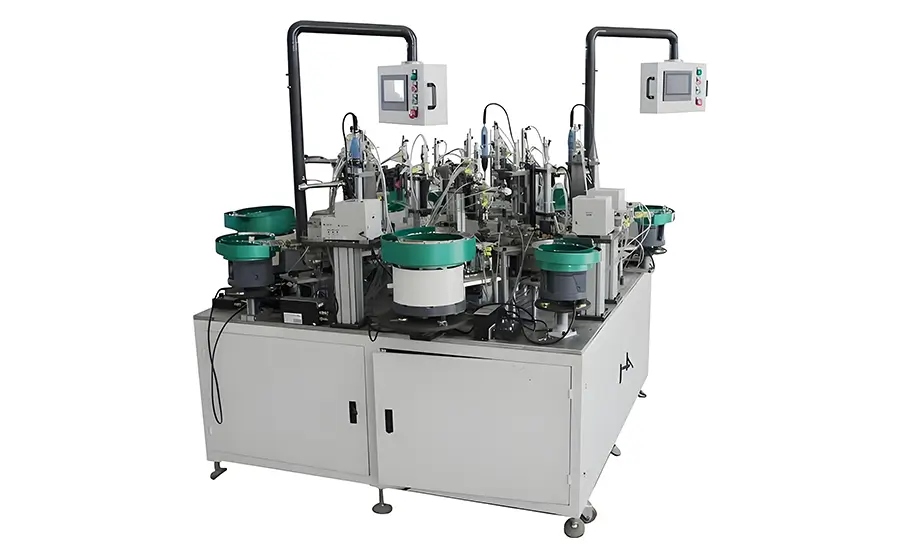
As a result, more manufacturers are upgrading to automation solutions such as the plug assembly machine to improve production capability and reduce operational costs.
So, what is the real difference between a plug assembly machine and manual assembly? Let’s compare them in detail.
Production Efficiency: Machines Deliver Stable Output
Manual assembly depends heavily on worker skill, fatigue level, and workforce size. This often leads to inconsistent production output.
In contrast, a plug assembly machine operates continuously with stable cycle time, ensuring consistent high-speed production without human limitations.
Product Quality: Automation Ensures Consistency
Manual assembly may lead to issues such as:
- Misaligned pins
- Inconsistent pressing force
- Missing or incorrect assembly steps
A plug assembly machine uses precision positioning systems and PLC control to ensure every product is assembled with consistent quality.
Labor Cost: Automation Reduces Long-Term Expenses
Manual assembly requires multiple operators, supervisors, and quality inspectors, increasing long-term labor expenses.
A plug assembly machine requires only a small number of operators for monitoring and maintenance.
Production Stability: Machines Perform Better for Continuous Operation
Human-based production is affected by:
- Staff turnover
- Fatigue
- Skill differences
These factors reduce production stability.
Automated systems can run continuously with minimal interruption, making them ideal for mass production environments.
Safety and Management
Manual assembly carries risks such as repetitive strain injuries and human error.
Automated plug assembly machines reduce manual handling, improve workplace safety, and simplify production management.
Overall Comparison
| Factor | Manual Assembly | Plug Assembly Machine |
| Production Efficiency | Unstable | High & consistent |
| Product Quality | Variable | Highly consistent |
| Labor Cost | High | Low |
| Long-term Cost | Increasing | More controllable |
| Stability | Human-dependent | Stable operation |
| Safety | Medium risk | Higher safety |
Why Malaysian Manufacturers Are Moving Toward Automation
With rising labor costs and increasing quality requirements, more manufacturers in Malaysia are investing in automation technologies such as plug assembly machines, feeding systems, and vision inspection systems.
SWOER Malaysia provides complete automation solutions including:
- Plug assembly machines
- Vibratory bowl feeding systems
- Vision inspection systems
- Full production line integration
Helping manufacturers achieve higher efficiency, lower cost, and smarter production.
Conclusion
A plug assembly machine is not just a replacement for manual labor—it is a strategic upgrade for modern manufacturing.
For Malaysian electronics manufacturers, adopting automation early provides a strong competitive advantage in efficiency, quality, and cost control.
FAQs
It can significantly reduce manual work, but some operators are still required for monitoring and maintenance.
Yes, it is suitable for medium and large production volumes, and semi-automatic options are also available.
Initial cost is higher, but long-term savings from labor and efficiency make it cost-effective.
Yes, it supports different plug models with quick changeover and parameter adjustment.
Yes, SWOER Malaysia provides complete production line solutions from feeding to assembly and inspection.
